The Five Zones of Masking
Jun 22, 2026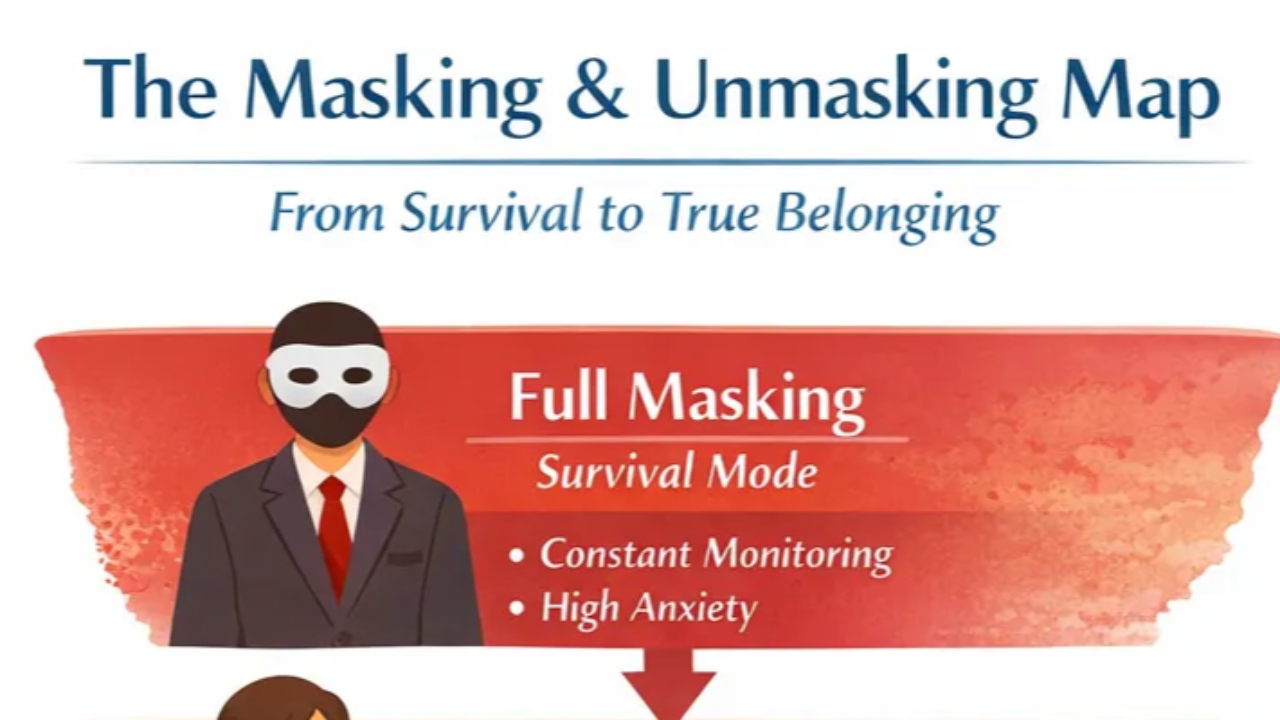
You’re in a conversation, smiling, nodding, responding appropriately.
You’re competent. Polite. Engaged.
You say the right things.
You make eye contact at the right intervals.
You laugh when others laugh.
And yet, beneath the surface, there’s a quiet exhaustion from the effort of performing the interaction in a way that feels acceptable.
This is masking. Sometimes it’s maligned as deception, manipulation or inauthenticity. However, essentially, it’s adaptation for the purpose of protection. A deeply intelligent nervous system learning how to survive in environments that weren’t designed with it in mind.
For many of us - especially those who are sensitive, bright, perceptive, empathic, and complex - masking becomes so habitual that it disappears from conscious awareness. It becomes the air we breathe. The background operating system. The quiet choreography of daily life.
If this is you, then welcome. Let’s explore this misunderstood experience and navigate it with compassion rather than shame.
Masking Is A Developmental Strategy
Many of us grew up in environments where our natural responses were misunderstood or discouraged. We may have been told, “Don’t be so sensitive.” “Try harder to focus.” “Stop overreacting.” “Why can’t you just be like everyone else?” “You’re too much.” “You’re not trying hard enough.”
These messages - often delivered without malice - imply that our natural way of being isn’t acceptable.
Children are exquisitely attuned to belonging. When belonging feels threatened, adaptation begins. We learn to hide confusion, suppress emotions, imitate social behaviour, over-prepare, monitor ourselves constantly, perform competence, minimise needs, and anticipate reactions.
Over time, these behaviours become automatic because our nervous system is protecting connection. Masking is relational intelligence under pressure.
The Hidden Cost of Masking
Masking works, until it doesn’t. It helps us succeed academically, maintain relationships, avoid conflict, appear capable and meet expectations.
However, it also carries a physiological cost such as chronic fatigue, anxiety or hypervigilance, burnout, social exhaustion, identity confusion, emotional numbness, delayed recognition of needs and a persistent sense of “not quite being yourself.”
This is because sustained self-monitoring requires energy. Imagine holding a muscle slightly tensed all day. Not enough to cause pain immediately, but enough to create strain over time. Masking works the same way.
Unmasking Isn’t About Dropping the Mask Everywhere
One of the most harmful myths about unmasking is the idea that it means radical, unfiltered authenticity at all times. That’s neither realistic nor safe.
Healthy unmasking is about choice. It’s the difference between performing automatically and adapting intentionally. It’s the shift from survival to self-awareness.
Unmasking doesn’t mean saying everything we think, ignoring social norms, abandoning professionalism or becoming emotionally unfiltered. Unmasking means knowing when we’re adapting, and why.
Seeing Our Own Masking
Masking often begins in early childhood, long before self-reflection develops. It becomes habitual, automatic, unconscious. We may believe: “This is just who I am.” “Everyone feels this way.” “I’m just tired.” “I’m bad at socialising.” “I’m not resilient enough.”
However, what we’re experiencing may have nothing to do with our personality.
What follows aims to help you recognise where masking happens in your life, so that you can respond with understanding rather than self-criticism.
The Five Masking Zones
(Bullet-pointed for ease of reading)
Zone 1 - Full Masking
Survival Mode
This is where the nervous system prioritises safety over authenticity.
Common signals:
-
constant self-monitoring
-
rehearsing conversations
-
suppressing emotions
-
copying others’ behaviour
-
feeling tense or hyper-alert
-
exhaustion after interaction
Common environments:
-
unfamiliar social settings
-
workplaces with high expectations
-
authority figures
-
performance situations
-
conflict-prone environments
Inner experience: “I have to get this right.”
Zone 2 - Strategic Masking
Functional Adaptation
This is intentional adjustment to meet situational demands.
Common signals:
-
choosing professional language
-
managing emotional expression
-
maintaining structure
-
following social conventions
Common environments:
-
meetings
-
public speaking
-
professional roles
-
structured group settings
Inner experience: “I know how to do this.”
Zone 3 - Partial Unmasking
Selective Authenticity
Here, authenticity begins to emerge, but with caution.
Common signals:
-
sharing opinions carefully
-
expressing needs tentatively
-
relaxing some social monitoring
-
feeling more at ease, but still aware
Common environments:
-
trusted colleagues
-
acquaintances
-
semi-familiar social groups
Inner experience: “I can be myself, mostly.”
Zone 4 - Safe Unmasking
Nervous System Ease
This is where the body feels regulated and secure.
Common signals:
-
relaxed posture
-
spontaneous speech
-
natural emotional expression
-
reduced mental effort
-
sustained energy
Common environments:
-
close friendships
-
supportive family members
-
creative spaces
-
quiet environments
Inner experience: “I don’t have to perform here.”
Zone 5 - True Belonging
No Performance Required
This is the rare and powerful experience of being fully accepted as you are.
Common signals:
-
deep relaxation
-
emotional safety
-
sustained presence
-
authentic expression
-
minimal recovery time
Common environments:
-
deeply trusted relationships
-
aligned communities
-
spaces of shared values
Inner experience: “I am safe to exist exactly as I am.”
The Pattern Recognition Layer
How to Identify Your Masking Patterns
Below are the dimensions where masking most often occurs. You don’t need to analyse everything. Simply notice patterns.
1) Communication Masking
You might:
-
rehearse what to say
-
avoid asking questions
-
hide confusion
-
mirror others’ tone or language
-
overexplain
-
speak less than you want to
Invisible signal: Mental fatigue after conversations
2) Emotional Masking
You might:
-
suppress strong feelings
-
minimise distress
-
smile when overwhelmed
-
delay emotional expression
-
appear calm while internally dysregulated
Invisible signal: Delayed emotional reactions
3) Cognitive Masking
You might:
-
work harder than necessary
-
double-check excessively
-
avoid showing uncertainty
-
hide processing delays
-
compensate through perfectionism
Invisible signal: Mental exhaustion after routine tasks
4) Sensory Masking
You might:
-
tolerate discomfort silently
-
ignore noise or light sensitivity
-
stay in overwhelming environments
-
suppress stimming behaviours
-
endure physical discomfort
Invisible signal: Sudden shutdown after stimulation
5) Social Masking
You might:
-
imitate social behaviour
-
force eye contact
-
maintain conversation beyond comfort
-
laugh when unsure
-
hide social fatigue
Invisible signal: Needing extended recovery time after interaction
The Masking Cost Calculator
Gently consider:
-
Where do you feel most exhausted after interaction?
-
Where do you feel most alert or tense?
-
Where do you feel relief when leaving?
-
Where do you feel most like yourself?
These are data points.
The First Step Towards Unmasking
Many of us believe we must immediately:
-
speak differently
-
set boundaries
-
change behaviour
-
confront others
-
explain ourselves
However, the nervous system doesn’t change through force. It changes through safety.
The first step is simply: Noticing where you’re masking.
A More Compassionate Definition of Unmasking
-
recognise your needs
-
adjust your environment
-
choose your responses
-
honour your energy
-
remain connected to yourself
Even while adapting to the world.
Summary + Questions
Masking is a story of adaptation. Unmasking is a gradual return to the self that has been there all along. It was quietly waiting beneath the performance for a place where it can finally rest.
What masking zone do you find yourself in most of the time?
How do you feel about unmasking?
Where does it feel safe for you to unmask?
