The Self-Discovery Map of Neurodivergence
Jun 22, 2026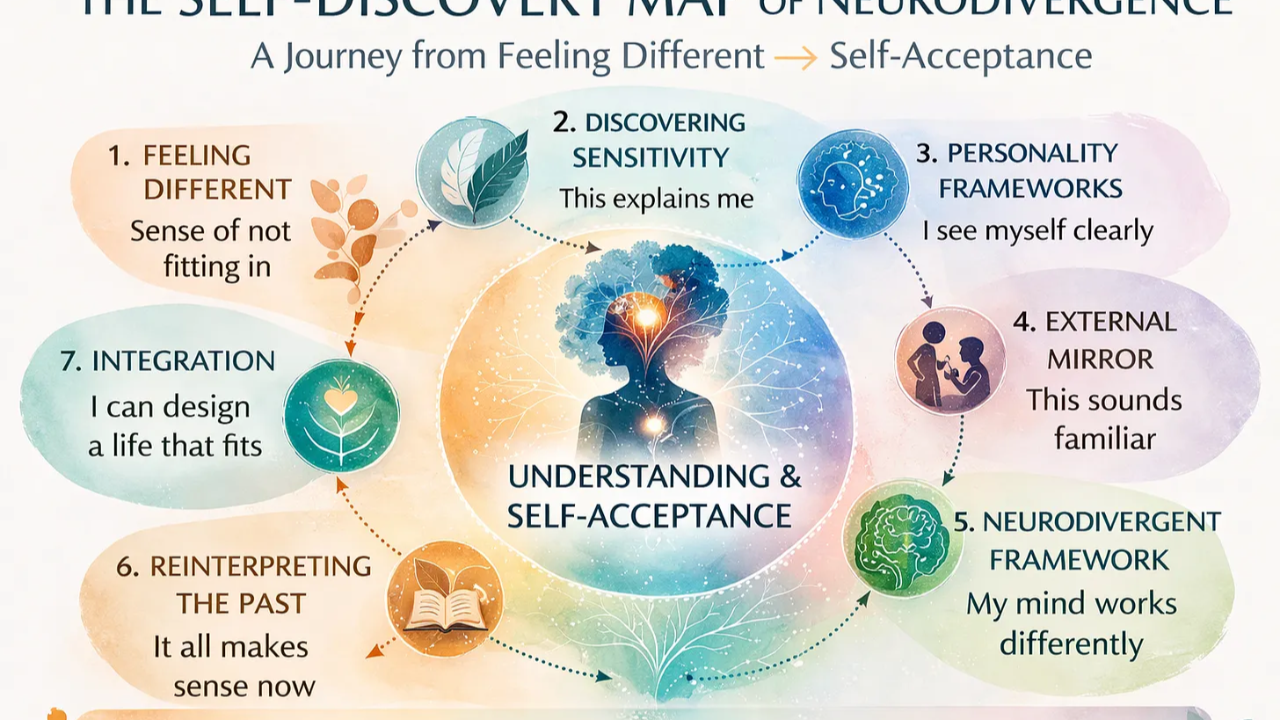
Sometimes awareness of neurodivergence unfolds slowly across decades. It emerges through layers of curiosity, confusion, exhaustion, pattern recognition, and emotional recalibration. In hindsight, the signs were always there, but what was missing was the framework.
Below is a pattern that appears again and again in the stories of neurodivergent adults. Not everyone moves through these stages, and not everyone experiences them in the same order – it’s rarely a linear process. Some stages blur together, but overall, they form something like a developmental map of discovery.
Stage 0 — The Pre-Story
Long before anyone speaks about neurodivergence, there’s often a childhood filled with contradictions.
Adults might describe the child in paradoxes. Teachers might say the child is capable, but underperforming. Parents might feel both proud and perplexed. Peers may sense difference before language exists for it.
At this stage nothing feels “wrong” yet.
Instead, the environment begins shaping a variety of coping strategies. The child learns which traits are welcomed and which create friction. They learn to soften certain impulses, amplify others, and observe the social rules around them with unusual intensity.
Early masking often begins here as adaptation. The story of the self hasn’t yet formed, but the emotional backdrop is already being written.
Stage 1 — The Sense of Being Different
Growing up, we begin to feel a subtle but persistent sense of not quite fitting the expected patterns. This feeling of difference can show up as questions:
Why do things that seem easy for others feel difficult for me?
Why does my mind race in some areas, but stall in others?
Why do I feel overwhelmed by environments that others seem to tolerate easily?
We may have produced something that was advanced for our age. We may have undertook a complex task that felt intrinsically rewarding and cared not one jot about praise or approval. We may have mastered a piece of music or a gymnastic routine and been called a “show off” because it was unusually skilful.
Stage 1.5 – The Self-Blame Loop
Between the first sense of difference and deeper discovery, some of us can enter a long period of trying harder.
If something isn’t working, the most available explanation is character. Perhaps the problem is discipline. Perhaps it’s motivation. Perhaps it’s moral weakness, laziness, selfishness, emotional fragility, or lack of willpower.
This stage often produces familiar patterns: perfectionism, people-pleasing, emotional suppression, intellectual overcompensation, and mimicking others to appear competent.
From the outside, this can look like achievement. From the inside, it often feels like running a marathon on unstable ground.
Years, sometimes decades, can pass inside this loop of “too much” and “not enough.”. Which is why later discovery of neurodivergence can carry a strange mixture of relief and grief. Relief that nothing was fundamentally wrong. Grief for all the years spent trying to fix what was never broken.
Stage 2 – Personality Frameworks
Eventually, we may begin exploring personality systems.
The Myers-Briggs Type Indicator. The Enneagram. Strengths assessments. Learning style frameworks.
These systems can provide the first structured explanation for why we might feel different from those around us. We may discover we’re highly introverted, deeply intuitive, or unusually analytical. These frameworks can be validating. For the first time, inner experience begins to feel legible. However, these frameworks can also leave an unfinished feeling – as if the explanation is pointing towards something deeper that hasn’t yet been fully named.
Stage 2.5 – The First Crack in the Story
Eventually something happens that the old explanations can’t account for. A burnout that doesn’t resolve. A project that collapses under invisible strain. A social rupture that feels inexplicable. A body that begins signaling stress through exhaustion, illness, or shutdown.
For years we might rely on effort to overcome friction, but now effort stops working. Something no longer bends. This moment introduces a new realisation:
The story I’ve been telling myself doesn’t explain my reality.
And once that crack appears, curiosity begins widening it.
Stage 3 — Sensitivity as a Clue
The next stage may arrive through the concept of high sensitivity. The idea that some people process the world more intensely – emotionally, cognitively, and sensorily.
We recognise ourselves in descriptions of deep empathy, strong reactions to noise or chaos, rich inner worlds, emotional intensity and overstimulation.
The Highly Sensitive Person framework offers a compassionate lens for experiences that once felt like personal flaws. Yet even here, something often remains unexplained.
Sensitivity explains intensity, but it doesn’t fully explain the mind itself.
Stage 3.5 — The Cognitive Puzzle
At this stage, we may begin examining the architecture of our thinking. Questions multiply.
Why can I grasp complex ideas instantly, but forget simple instructions?
Why can I hyper-focus for twelve hours yet struggle to begin ordinary tasks?
Why do I see patterns others miss while feeling lost in environments others navigate easily?
Why does my brain sometimes feel like a supercomputer, and sometimes like it’s vanished entirely?
Traits begin forming into a pattern, but the language remains incomplete. The puzzle pieces are visible. The picture is still emerging.
Stage 4 — Encountering Neurodivergence
Suddenly, descriptions of autistic cognition, ADHD patterns, or gifted intensity begin to resonate in unexpected ways. This stage can feel both electrifying and destabilising because the possibility emerges that difference may be neurological.
Stage 4.5 — The Mirror That Talks Back
Often recognition deepens through encounters with other people. A partner casually says: “You think a lot like my autistic friend.” A therapist gently asks about focus or sensory patterns. A colleague says, half jokingly: “You know… you might be one of us.”
These moments may feel small at first, but they linger. Eventually they become undeniable mirrors.
Stage 5 — The Research Spiral
Once the possibility enters awareness, curiosity becomes difficult to contain. We begin reading extensively. Scientific papers. Personal narratives. Community discussions.
We begin revisiting our childhood, relationships, work history, and emotional patterns through a new lens. Memories rearrange themselves. Events that once seemed random begin forming coherent patterns.
This stage can become an intense period of intellectual and emotional investigation.
Stage 5.5 — The Mixed Emotions Threshold
Recognition usually arrives in layers of emotion. Relief. Curiosity. Validation. Anger. Grief. Disbelief.
Common questions surface:
How did I not know?
How did everyone else miss this?
What might my life have looked like if I’d known earlier?
The nervous system finally has a name, but the psyche is still catching up.
Stage 6 — Reinterpreting the Past
As the framework settles, we begin revisiting our life story.
Childhood experiences. Friendships that felt confusing. Jobs that felt draining. Moments of brilliance that appeared and disappeared unpredictably.
What once looked like personal inconsistency begins to resemble neurological pattern. The past reorganises itself, and with that reorganisation often comes compassion for the earlier self who was navigating complexity without a map.
Stage 6.5 — Unmasking in Layers
Before full integration, we can enter a subtle phase of unmasking. This doesn’t mean abandoning all coping strategies. It means experimenting with authenticity in small increments.
We leave environments earlier when overwhelmed. We allow silence without apologising. We use sensory supports. We let our intensity show. We say “no” sooner.
Often this stage reveals the hidden cost of decades of adaptation. The nervous system begins relaxing in ways it never previously could.
Stage 7 — Integration
The question shifts from “What’s wrong with me?”
to, “How does my mind actually work?”
Instead of forcing ourselves into environments that require constant compensation, we may begin shaping our lives around alignment.
Work. Relationships. Creative expression. Energy rhythms. Integration is about understanding the person who was there all along.
Stage 7.5 — Rebuilding the Future
Before full stability arrives, we may pass through a stage of recalibration. Old goals are re-examined. Career paths are reconsidered. Relationships are renegotiated. Prestige begins mattering less than nervous-system compatibility. Sources of joy that were previously suppressed are rediscovered.
Community becomes important, not necessarily large communities, but spaces where explanation is unnecessary. We’re believed and supported.
The future begins to look different, and often, freer.
Stage 8 — Collective Integration
Eventually the journey becomes larger than the individual. We may begin contributing to broader conversations. We become advocates. Mentors. Community builders or simply people who quietly support others beginning the same journey.
We question cultural norms around productivity, communication, education, and emotional expression.
The question is no longer just: How do I adapt to the world?
It becomes: How might the world adapt to the diversity of minds within it?
At this stage neurodivergence stops being a private realisation. It becomes part of a collective cultural shift.
We finally recognise someone who was present all along. The signs were there. The patterns were there. The mind was always working exactly as it was built to work.
What changes is the story, and sometimes, changing the story changes everything.
